

A Pet Owner’s Guide to Normal Vital Signs for Dogs
As a pet owner in Queens, learning to spot the difference between your dog being "a little off" and having a real problem is one of the most important things you can do. The key is knowing your dog's normal vital signs. Using clear, calm language, this guide will walk you through what to look for.
A healthy adult dog that's calm and resting should have a rectal temperature between 101°F and 102.5°F, a heart rate of 60-140 beats per minute, and a breathing rate of 15-30 breaths per minute. Think of these numbers as your dog's baseline—knowing them makes it much easier to tell when something is wrong.
Your Dog's Health by the Numbers

For pet owners from Bayside to Fresh Meadows, understanding these numbers helps you become a better advocate for your dog's health. The goal isn't to replace your vet, but to catch problems early so your dog gets the right care at the right time.
Think of it like knowing the normal sounds your car makes. The moment you hear a new rattle, you know it's time for a check-up. Checking your dog's vitals gives you that same early warning system.
What Are Canine Vital Signs?
Vital signs are the basic measurements that give us a snapshot of how your dog's body is functioning. When we check vitals, we're looking at a core set of numbers:
- Temperature: Tells you if your dog has a fever or is too cold (hypothermia).
- Heart Rate (Pulse): Measures how fast their heart is beating.
- Respiratory Rate: Counts how many breaths they take each minute.
- Mucous Membrane Color: The color of your dog's gums is a quick indicator of blood circulation and oxygen levels.
- Capillary Refill Time (CRT): This fast check of the gums also tells us about circulation and hydration.
These are the same fundamental checks we perform during wellness exams. You can see everything that's included in a complete check-up in our guide to preventive veterinary care.
The most important number isn't a textbook "normal"—it's your dog's normal. By checking vitals when your dog is healthy and relaxed, you establish a personal baseline. That makes it much easier to spot a real problem when they feel sick.
Why Monitoring at Home Matters
As a pet parent in a busy neighborhood like Oakland Gardens or Queens Village, you're your dog's first line of defense. Knowing how to check these vitals at home is a huge advantage.
It helps you give our veterinary team specific, practical information. Instead of just saying, "he seems off," you can report, "his resting breathing rate is 40 breaths per minute, and his gums look a little pale." That level of detail helps us assess the situation much more accurately.
If you ever notice concerning symptoms or abnormal vital signs, don't wait. Text us at 718-301-4030. If symptoms are severe or after hours, go directly to a 24/7 emergency hospital.
Measuring Your Dog’s Heart and Breathing Rates

Knowing how to check your dog's heart rate and breathing is a powerful skill. It might sound intimidating, but it's a simple, practical step you can take for your pet's well-being.
These two numbers give you a direct window into your dog's health. The trick is to check them when your dog is relaxed and resting—not right after a game of fetch in the park.
How to Check Your Dog’s Heart Rate
You don't need a stethoscope to find your dog's pulse. The easiest spot is the femoral artery, which is located high up on the inside of their back leg, right where it meets the body.
- Step 1: Gently place two fingers (not your thumb) on this spot. You're feeling for a soft, steady beat.
- Step 2: Once you find it, count the beats for 15 seconds.
- Step 3: Take that number and multiply it by four. This gives you the beats per minute (bpm).
If you’re having trouble, just place your flat hand on the left side of their chest, right behind the elbow. You should be able to feel the heartbeat there.
How to Check Your Dog's Breathing Rate
A healthy dog’s breathing should be quiet and effortless when they are resting. To check their respiratory rate, simply watch their chest rise and fall.
- Step 1: Wait until your dog is resting calmly or even asleep.
- Step 2: Count how many times their chest rises and falls in 30 seconds. (One rise and one fall counts as one breath.)
- Step 3: Multiply that number by two to get the total breaths per minute.
Panting after play is normal, but heavy, noisy, or shallow breathing while resting is a major red flag. Knowing what’s normal is crucial. For more details, see our guide to the signs of respiratory distress in dogs.
Normal Heart & Respiratory Rates in Dogs at Rest
Here is a quick reference for typical resting vital signs. Keep in mind that a dog's normal heart rate changes a lot based on their size and age.
| Dog Category | Normal Heart Rate (beats per minute) | Normal Respiratory Rate (breaths per minute) |
|---|---|---|
| Puppies (under 1 year) | 120 – 160 | 15 – 40 |
| Small Dogs (under 30 lbs) | 100 – 140 | 15 – 30 |
| Medium/Large Dogs (over 30 lbs) | 60 – 100 | 15 – 30 |
For example, a puppy's heart can beat as fast as 120-160 bpm, while a giant breed adult dog might have a slow, steady pulse of just 60-90 bpm. Every dog is different, but these ranges are a great starting point.
Important Takeaway: A heart rate that is consistently too fast (tachycardia) or too slow (bradycardia), or a resting breathing rate over 40 breaths per minute, are all reasons to contact a vet. These can be signs of pain, anxiety, heart problems, or respiratory disease.
If you check your dog's vitals and something feels off, trust your gut. Text us at 718-301-4030. If symptoms are severe or after hours, go directly to a 24/7 emergency hospital.
How to Take Your Dog's Temperature Safely
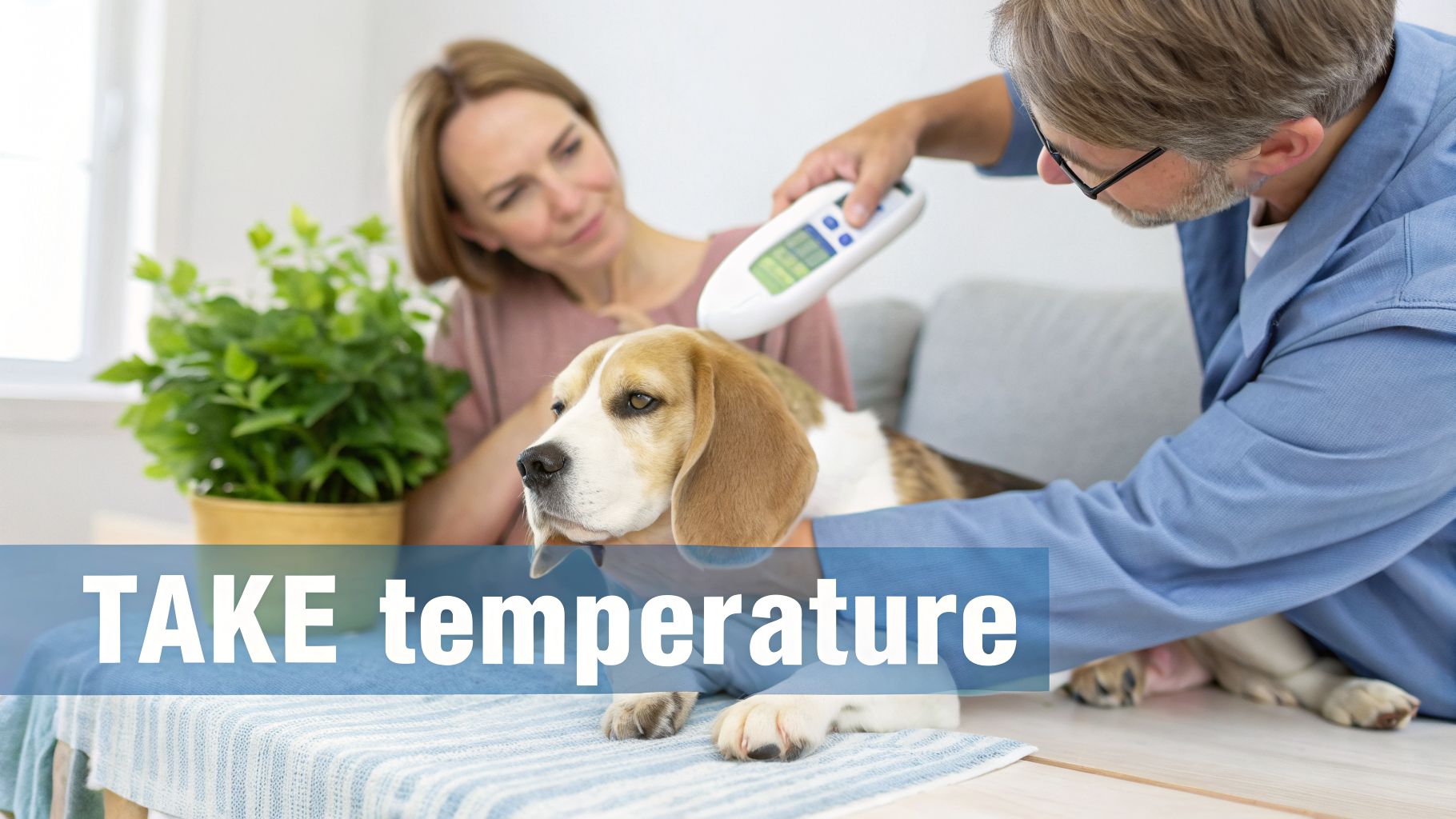
Your dog's temperature is one of the clearest signs of what's going on inside their body. While it might feel intimidating, learning to take it at home is a skill every pet owner from Hollis to Glen Oaks can master.
First, you need the right tool. Grab a digital rectal thermometer from any pharmacy. Don't use an old-school glass one that can break, and don't rely on a human ear thermometer—they aren't accurate for dogs.
A Step-by-Step Guide
The goal here is to make this quick and stress-free. A two-person team is best: one to gently hold and comfort your dog, and one to take the temperature. High-value treats are your friend for creating a positive experience.
- Get Ready: Have your digital thermometer, a water-based lubricant (like K-Y Jelly), and some treats within arm's reach.
- Lube Up: Put a good amount of lubricant on the tip of the thermometer.
- Position Your Pup: As your helper distracts your dog with praise and treats, gently lift their tail.
- Insert and Wait: Carefully slide the thermometer about one inch into your dog's rectum. Never force it. Hold it steady until the thermometer beeps, then gently slide it out.
- Praise and Clean: Check the reading and immediately praise your dog. Afterward, clean the thermometer thoroughly with rubbing alcohol.
Understanding the Results
Knowing the normal vital signs for dogs is key to making sense of the number you see. Remember, a healthy dog's temperature runs a bit higher than ours.
- Normal: 101°F to 102.5°F (38.3°C to 39.2°C) is right where you want it to be.
- Low-Grade Fever (Urgent): A reading of 103°F to 104.5°F is a fever, meaning the body is fighting something off. This warrants a call or text to your vet for guidance.
- Hypothermia (Urgent): If the temperature is below 99°F, your dog is dangerously cold. This requires immediate advice from a vet.
- High Fever (Emergency): 105°F or higher is a true emergency. A fever this high can quickly lead to organ damage. Get to a veterinary hospital immediately.
Important: Never give your dog human medications like Tylenol or Advil, only if your veterinarian advises. Many of these are toxic to dogs.
If your dog’s temperature is in the urgent range—or if any abnormal reading is paired with other symptoms like shivering or not eating—it’s time to act. Text us at 718-301-4030. If symptoms are severe or after hours, go directly to a 24/7 emergency hospital.
Checking Gum Color and Hydration Status

You don’t need fancy equipment to get a read on your dog’s health. Some of the most critical clues are right there in their mouth and skin. A quick look can tell you a lot about their circulation and hydration.
Learning these simple checks is one of the most powerful things pet owners in neighborhoods from Little Neck to Hollis can do. It helps you catch problems before they become emergencies.
What Is a Normal Gum Color?
Healthy dog gums should be a nice “bubblegum pink” and feel moist to the touch. This shows that their body is getting plenty of oxygen-rich blood.
To check, just gently lift your dog’s upper lip and take a look at the tissue above their teeth.
Some breeds like Chow Chows have naturally dark or black gums, which is normal for them. If your dog has pigmented gums, try to find a pink patch to check, or get used to looking at the color of their tongue or the inside of their lower eyelid instead.
The Capillary Refill Time (CRT) Test
This is one of the fastest ways to check your dog's circulation. We call it the Capillary Refill Time (CRT), and it only takes a couple of seconds.
- Gently lift your dog's lip to see their pink gums.
- Press your index finger firmly against the gum for a second.
- Quickly lift your finger. The spot you pressed will go white.
- Count how long it takes for the pink color to flood back in.
A normal CRT is fast—less than two seconds. If it takes longer, it can be a red flag for dehydration, poor circulation, or even shock. This is crucial information to give a vet.
How to Check for Dehydration
Here’s another quick check you can do at home: the "skin tent test." It gives you a good general idea of your dog's hydration level.
- How to do it: Gently grab a loose fold of skin on your dog’s back, between their shoulder blades.
- What to look for: When you let go, the skin should snap right back down almost instantly.
- What it means: If the skin sinks back slowly—or worse, stays “tented” up—your dog is likely dehydrated.
If you see pale, white, blue, or yellow gums, or if the CRT is longer than two seconds, you need to act fast. Text us at 718-301-4030. If symptoms are severe or after hours, go directly to a 24/7 emergency hospital.
When Abnormal Vital Signs Signal an Emergency
Knowing your dog's normal vital signs is the first step. The second—and most critical—is understanding when a strange reading means you need to act fast. For pet owners in Queens neighborhoods like Oakland Gardens and Bayside, this knowledge helps you make the right call.
Urgent vs. Emergency: Knowing the Difference
Some situations are concerning but might not require a rush to an ER. These are times to contact us for guidance.
Urgent Symptoms (Contact Us):
- Mild Fever: Rectal temperature between 103°F and 104.5°F.
- Slightly Elevated Vitals: A resting heart or breathing rate that’s a little high, but your dog is otherwise acting normally.
- Mild Dehydration: The skin tent is a bit slow to return, but they’re still drinking water.
- Lethargy: Your dog seems a little "off" or tired but is still responsive and moving around.
Emergency Symptoms (Go to a 24/7 Hospital Immediately):
- Temperature Crisis: A temperature of 105°F or higher, or below 99°F.
- Trouble Breathing: Labored breathing, gasping, wheezing, or a resting breathing rate over 40 breaths per minute.
- Poor Circulation: Gums that are pale, white, blueish, or brick red, or a Capillary Refill Time (CRT) longer than two seconds.
- Collapse or Seizure: Your dog collapses, has a seizure, or is unresponsive.
- Severe Pain: Crying out, inability to get comfortable, or aggression when touched.
What to Do Before You Arrive
If you are heading to an emergency hospital, stay calm and take these practical steps:
- Call Ahead: Let the emergency hospital know you are coming and describe your dog's symptoms. This helps them prepare.
- Bring Key Info: If possible, grab any medications your dog is taking and know their basic medical history.
- Drive Safely: Your priority is getting there safely. Keep your dog secure in the car, either in a crate or with another person holding them.
For more details, check our guide on when to take your dog to an emergency vet.
Text us at 718-301-4030. If symptoms are severe or after hours, go directly to a 24/7 emergency hospital.
A Quick FAQ About Your Dog's Vitals
Here are calm, straightforward answers to the most common questions from caring owners across Queens.
Can I use a human thermometer on my dog?
Yes, but with an important rule. You can use a standard digital thermometer, but once you use it rectally on your dog, it becomes their thermometer. Label it clearly and do not share it with people in your home. Forehead or ear thermometers we use for people do not work reliably on dogs.
Is it normal for my dog's heart to beat fast during play?
Absolutely. Just like ours, a dog’s heart rate will speed up during a good run in the park. That's perfectly normal. The number that really matters is their resting heart rate—the rate when they are calm and relaxed. A fast heartbeat is only a worry if it stays high long after the fun is over, or if it comes with other signs like weakness or coughing.
What if my dog fights me when I try to check their vitals?
Your safety and your dog's comfort are the top priority. Never force it. If your dog is getting stressed, scared, or aggressive, stop. A dog being too painful or anxious to be handled is a huge red flag all by itself. Instead, observe them from a distance. If you're worried but can't safely get their vitals, it's always better to be cautious and seek veterinary advice.
Text us at 718-301-4030. If symptoms are severe or after hours, go directly to a 24/7 emergency hospital.
