

Over the Counter Cat Sedative: A Queens Vet’s Guide
The carrier is out. Your cat has already disappeared under the bed.
You’re trying to get to a vet appointment in Oakland Gardens, drive to a family member’s home in Bayside, or manage a weekend full of noise and visitors in Queens Village. Your cat is drooling, growling, panting, or refusing to come out. At that moment, typing “over the counter cat sedative” into your phone feels completely reasonable.
It’s also where many owners get tripped up. Shelf products often look gentle, natural, and simple. Cats are not simple patients. A calming chew that helps one cat rest may do very little for another, and a product labeled herbal or natural can still cause problems if the dose, ingredients, or timing are wrong.
When Your Cat's Stress Becomes Your Stress
A lot of cat anxiety starts with ordinary life. A carrier appears. The hallway gets noisy. Guests arrive. A thunderstorm rolls across Fresh Meadows. A grooming appointment is coming up, or you need to get your cat across Queens for a medical visit.
For some cats, that stress stays mild. They hide, vocalize, or skip a meal. For others, it escalates fast. They scratch when handled, urinate in the carrier, breathe rapidly, or become so panicked that getting them safely out the door feels impossible.
That’s why over the counter calming products are so appealing. Owners want something that feels kinder than a heavy sedative and easier than a prescription. In many situations, that instinct makes sense. Some nonprescription products can take the edge off predictable, mild stress.
The right question usually isn’t “What can I buy?” It’s “What level of fear am I trying to treat, and what could make this unsafe for my cat?”
That distinction matters. A cat with mild travel nerves is different from a cat with severe panic, pain, breathing disease, or a history of reacting badly to handling. Those cats may need a different plan entirely.
There’s also a second issue that owners often miss. Anxiety can be the visible sign of something else. Cats in pain may act “nervous.” Cats with dental disease may fight handling because their mouth hurts. Cats with urinary discomfort may seem agitated, restless, or avoid the litter box. If you only focus on calming the behavior, you can miss the medical reason behind it.
What owners usually notice first
Common signs of stress in cats include:
- Hiding more than usual and resisting contact
- Vocalizing, especially in the car or carrier
- Drooling or panting during transport or handling
- Dilated pupils and tense body posture
- Trying to escape or swatting when approached
- Skipping meals around stressful events
- Over-grooming or grooming patches thin over time
- Litter box changes during or after stressful episodes
A safe plan starts with matching the tool to the cat, not the marketing on the label.
Understanding Over the Counter Calming Products
Owners often use the word sedative for anything sold to calm a cat, but most over the counter products are not true sedatives. They are mild calming aids. That difference matters because it changes what you can realistically expect them to do.
A cat with mild tension during travel may settle a bit with the right OTC product. A cat that panics, cannot be handled safely, or has a history of biting and injuring itself usually needs a different plan. This is one of the main reasons I tell owners to call before trying even a product that looks gentle on the shelf. The safety question is not only what is in the bottle. It is whether that product matches the cat in front of you.
What OTC calming products are actually meant to do
These products are usually designed to soften mild stress responses. They may help a cat stay a little calmer in the carrier, recover faster after a disruption, or show less reactivity in a familiar stressful situation. They do not usually produce reliable, predictable sedation.
That distinction is where owners get frustrated. The product may be doing exactly what it was designed to do, but the cat needs stronger support than a supplement or pheromone can provide.
What these products usually contain
You will usually see a few broad types of calming aids:
- Nutritional or amino acid ingredients, such as L-theanine or tryptophan
- Milk protein derived ingredients, including alpha-casozepine
- Herbal ingredients, such as valerian root or catnip extract
- Pheromone products, often sold as sprays, diffusers, or collars
- Occasionally antihistamines or other drugs, which should only be used under veterinary guidance
Each category comes with trade-offs. Chews and powders are easy to give if a cat will eat before a stressful event. Sprays and diffusers avoid oral dosing, but their effects are usually subtle. Herbal blends appeal to owners looking for a natural option, but natural does not mean low risk, consistent, or well studied in cats.
Why veterinary advice still matters for “safe” shelf products
Over the counter does not mean appropriate for every cat.
Cats process medications and supplements differently from people and dogs. Age, kidney or liver disease, heart disease, pain, appetite, current medications, and the type of stress response all change the risk calculation. A senior cat with hidden kidney disease is not the same as a healthy young cat with mild carrier anxiety. A flat-faced cat with noisy breathing needs a more cautious plan than a cat who just complains in the car.
The other reason to ask a veterinarian is that calming the behavior can hide the underlying problem. A cat that seems anxious during handling may have arthritis, dental pain, bladder discomfort, or nausea. In those cases, buying a calming product without looking at the cause can delay the right treatment.
Practical rule: If the goal is mild support for a predictable, low-risk stressor, an OTC calming aid may be reasonable. If the goal is safe handling for a vet visit, travel, grooming, or any situation where panic is likely, ask your veterinarian whether a prescription option is safer and more reliable.
Used carefully, OTC calming products can be part of a good plan. They are tools for selected situations, not a blanket solution for feline anxiety.
Decoding Labels of Common Cat Calming Aids
A calming label can sound reassuring while telling you very little that helps you judge safety. The useful parts are usually simple. What is the active ingredient, how is it given, how quickly is it supposed to work, and is the goal mild calming or actual sedation?
That difference matters. Many shelf products are better described as calming aids than sedatives.
Amino acids and nutrient-based ingredients
Ingredients such as L-theanine, tryptophan, and alpha-casozepine show up in products marketed for mild anxiety, travel stress, or trouble settling. These are usually chosen for a softer effect. A cat may seem less tense or recover from a stressor more easily, but many cats will not become sleepy.
Form matters as much as the ingredient. These products are commonly sold as:
- soft chews
- powders mixed into food
- capsules
- liquids
That sounds convenient until you consider the cat in front of you. A supplement mixed into food is a poor fit for a cat that stops eating when stressed. A capsule is not helpful if pilling already turns the event into a fight.
Herbal products and plant-derived ingredients
Herbal formulas often contain valerian root, catnip extract, or mixed botanical blends. Response is uneven. Some cats appear calmer. Some show no obvious change. Some become more alert, restless, or agitated.
This is one of the places where owners can get misled by the word “natural.” Natural describes where an ingredient comes from. It does not tell you whether the dose is consistent, whether the product has been studied well in cats, or whether it is a good match for a cat with heart disease, asthma, kidney disease, or a history of panic.
For mild household stress, an herbal product may be reasonable to discuss. For a cat that thrashes in the carrier or cannot be handled safely, these products are usually too unpredictable.
Milk protein and pheromone products
Zylkene and Feliway are often grouped together, but they do different jobs.
Zylkene contains alpha-casozepine, a milk protein derivative used for daily calming support in some cats. Feliway is a pheromone product used in the environment, not a sedative. It is meant to make the space feel more familiar and less threatening.
That distinction helps with label reading. If the stress is tied to the room, the carrier, or conflict in a multi-cat home, an environmental product may make more sense than another chew. If you are comparing shelf products with stronger medications, this guide to tranquilizers for cats and how they differ from calming aids gives useful context.
What about CBD?
CBD gets a lot of attention because owners hope it will feel gentler than prescription medication. The safer question is more specific. Is this exact product clearly labeled, consistently manufactured, and appropriate for this cat’s health history and current medications?
That is where risk assessment matters. CBD products vary widely in concentration, added flavorings, carrier oils, and quality control. Even when a compound may have calming or sedating effects, the bottle on the shelf may not be equivalent to the product used in a study. For cats with liver disease, appetite problems, or multiple medications, that uncertainty matters.
A label that promises calm is not enough.
Common Ingredients in OTC Cat Calming Products
| Ingredient | How It Works (Theory) | Best For | Things to Note |
|---|---|---|---|
| L-theanine | Supports a calmer mental state | Mild travel stress, mild situational anxiety | Usually supportive rather than strongly sedating |
| Tryptophan | Included to support calming and settling | Mild stress, routine anxiety support | Better suited to lower-level stress than panic |
| Valerian root | Herbal calming effect in some cats | Occasional stressors | Response can be inconsistent between cats |
| Catnip extract | May promote relaxation in some formulas | Mild situational stress | Some cats do not respond, and some become more stimulated |
| Alpha-casozepine | Milk-protein derived calming support | Ongoing household stress, vet visit preparation | Found in products such as Zylkene |
| Pheromones | Environmental comfort signal rather than sedation | Multi-cat homes, changes in home routine | Better for environmental management than event sedation |
| CBD | May affect behavior in some cats | Select situations under veterinary guidance | Product quality and consistency are major concerns |
The best labels make it easy to identify the active ingredient, the dose, and the intended use. The safest plan still starts before you buy it. Ask whether the product fits your cat’s medical risks, the type of stress involved, and the result you need.
OTC Calming Aids vs Prescription Sedatives
You are trying to get your cat into the carrier for a vet visit. One cat freezes and tolerates the trip with some encouragement. Another thrashes, pants, claws at the door, and arrives too frightened to be examined safely. Those cats do not need the same plan.
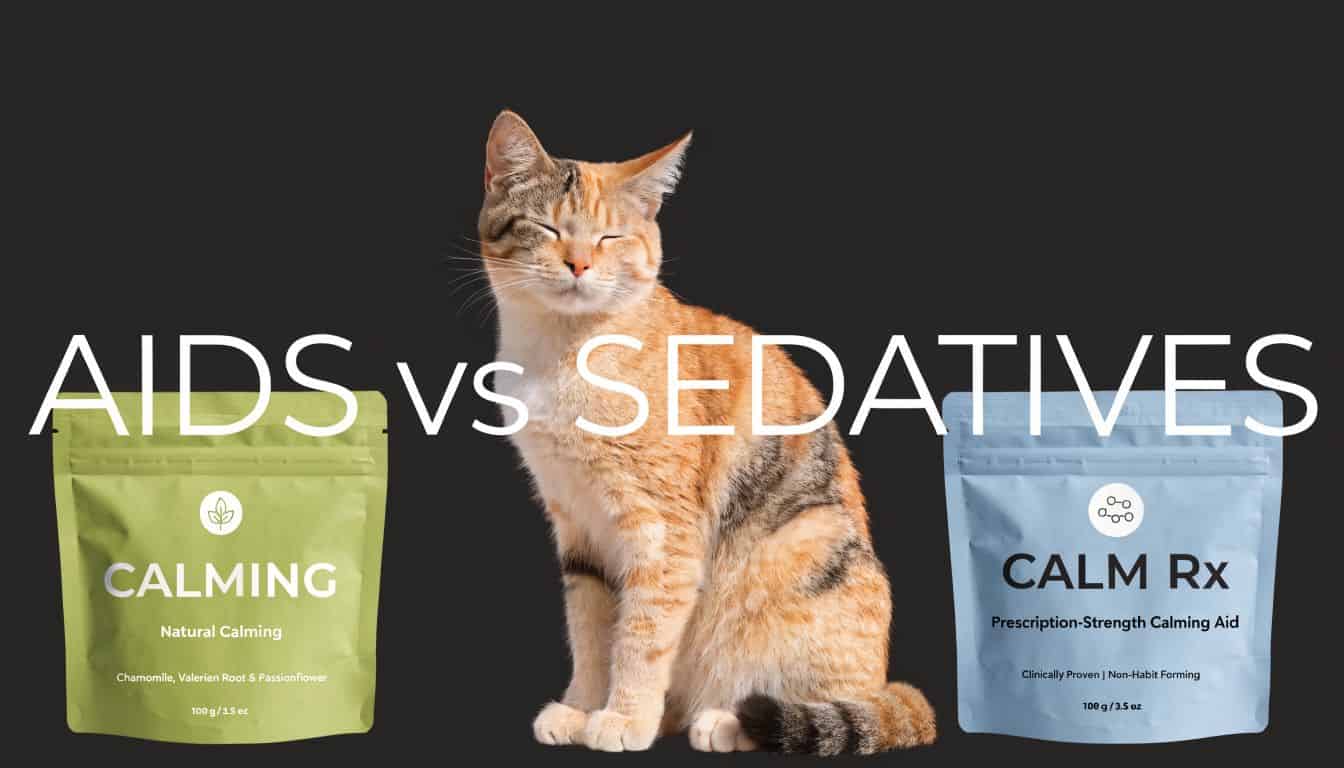
The primary difference between over the counter calming aids and prescription sedatives is predictability. OTC products can be useful for mild stress and for cats who stay functional when uneasy. Prescription medication is considered when the goal is more than taking the edge off. It is used when a cat is likely to panic, fight handling, or become so distressed that travel, examination, or grooming becomes unsafe.
When OTC support makes sense
OTC calming aids fit best when the problem is mild, predictable, and low risk.
A cat who gets restless during car rides, hides when visitors arrive, or tenses up before routine changes may benefit from a nonprescription product. In those cases, the product is usually one part of the plan. The bigger gains often come from timing, carrier practice, pheromones, noise reduction, and giving the cat a familiar place to retreat.
I tell owners to judge the situation by function. If the cat will still eat, can still be handled, and settles with support, an OTC trial may be reasonable after the cat’s health risks are reviewed.
When prescription medication is the safer choice
Prescription sedatives are a better fit when fear is intense or the situation is more serious.
Examples include the cat who has injured itself trying to escape a carrier, the cat who cannot be examined without extreme distress, or the cat whose panic turns a necessary trip into a medical and safety problem. In those cases, reliability matters more than shelf appeal. The question is not which option looks gentlest. The question is which option is most likely to reduce fear enough to keep the cat safe.
That is why a veterinary consultation matters even if a product is sold without a prescription. “Natural” and “over the counter” do not tell me whether it matches your cat’s age, weight, disease history, current medications, or the severity of the event. A cat with mild travel stress and a healthy exam is a very different patient from a senior cat with arthritis, kidney disease, or a past bad reaction to medication.
For owners who want a clearer sense of where veterinary medications fit, this overview of tranquilizers for cats explains why different drugs are chosen for different situations.
The practical trade-off
OTC aids offer gentler support, but the effect can be modest and inconsistent. Prescription sedatives carry more responsibility and require medical guidance, but they are often the more humane option when a cat is truly frightened.
That trade-off matters. Repeatedly trying mild products on a cat with severe fear can prolong the problem, delay care, and teach the cat that every carrier ride ends in panic. On the other hand, using a prescription approach for a cat with only mild situational stress may be more intervention than the cat needs.
The best choice depends on the cat in front of you, the type of stress involved, and how much reliability the situation requires. That is the veterinarian’s frame for risk assessment, and it is why the safest plan is not always the product that seems mildest on the shelf.
Are Over the Counter Sedatives Safe for Cats?
You are standing by the carrier an hour before a car ride, your cat is already tense, and the package on the shelf says “calming” and “natural.” That is the moment owners often assume the product is safe enough to try.
A safer question is different. Is this product appropriate for this cat, for this problem, today?
Over the counter calming aids can be reasonable for some cats with mild situational stress. They are not automatically safe just because they are easy to buy. In practice, I worry less about whether a product is sold without a prescription and more about whether the owner is treating the right problem, using the right ingredient, and giving it to a cat who can handle it.
The risk is not only side effects. The bigger problem is mismatch.
A cat who growls in the carrier may be fearful. That same cat may also be painful, nauseated, short of breath, or reacting to a past bad experience that a mild supplement will not touch. A senior cat with kidney disease, heart disease, or arthritis has a different safety profile from a young healthy cat with occasional travel stress. “Natural” does not sort that out for you.
Common problems with OTC calming products include:
- Vomiting or diarrhea
- Marked sleepiness
- Poor coordination or wobbliness
- Refusal to eat because the taste or texture is unpleasant
- Paradoxical agitation, where the cat becomes more restless instead of calmer
That last reaction surprises people, but it is real.
This is why veterinarians ask so many follow-up questions before giving a yes or no. We are trying to separate anxiety from pain, illness, and behavior change caused by something else. We are also checking for drug interactions, age-related risk, and whether the upcoming event needs a predictable effect or just mild support.
If your veterinarian recommends gabapentin, the goal is usually reliability and a wider safety margin under medical guidance, not a stronger product for the sake of it. This guide to gabapentin use in cats explains why it is commonly chosen for transport, vet visits, and handling stress.
Human medications deserve extra caution. Diphenhydramine is a common example because many owners already have it at home. That familiarity can create false confidence. Different formulations may contain added ingredients, and even plain products still need dose review and a medical check before use in cats.
If you are asking whether an OTC sedative is safe, the answer depends on your cat’s health, the ingredient, the dose, and what behavior you are trying to treat. That is why a brief veterinary conversation matters, even for products sold on an open shelf.
For owners in Oakland Gardens, Bayside, Fresh Meadows, Glen Oaks, Little Neck, Hollis, and Queens Village, a quick veterinary discussion can prevent avoidable mistakes.
Text us at 718-301-4030. If symptoms are severe or after hours, go directly to a 24/7 emergency hospital.
Calming Your Cat Without Medication
A lot of feline stress improves when you change the environment instead of the chemistry.
That matters because some cats don’t need an over the counter cat sedative at all. They need fewer surprises, safer hiding options, and gentler handling before the stressful event ever starts.
Start with the home setup
Cats cope better when they feel in control of their space.
Try these practical changes:
- Create hiding spots with covered beds, open carriers left out at home, or quiet closet corners
- Add vertical space such as cat trees, shelves, or window perches
- Protect quiet rooms from visitors, children, and other pets when possible
- Keep essentials spread out in multi-cat homes so food, water, and litter access don’t become social stress points
Many owners overlook the carrier itself. If the carrier only appears before a stressful trip, your cat learns to fear it. Leaving it out with bedding and treats can change that association over time.
Lower the stress before the stressful event
For travel days, grooming, or houseguests, preparation helps more than last-minute scrambling.
Useful steps include:
- Set the carrier out early so it becomes part of the room.
- Use familiar bedding that smells like home.
- Keep the room quiet while preparing.
- Avoid chasing your cat if they start to hide. That usually raises panic.
- Plan enough time so you’re not rushing.
A rushed owner often creates a rushed cat.
Build routines that support confidence
Cats like predictability more than people realize. A stable routine lowers baseline stress, which can make isolated events easier to handle.
Focus on:
- feeding on a regular schedule
- daily play sessions
- consistent litter box care
- gentle handling practice
- predictable household rhythms when possible
Some behavior changes that look like anxiety can overlap with medical issues. Litter box avoidance, restlessness, and repeated trips to the box should never be brushed off as stress alone. This article on preventing urinary tract issues in cats is a useful reminder that discomfort and anxiety often blur together in feline behavior.
Home calming plans work best when they reduce the cat’s baseline stress, not just the crisis of the moment.
Where non-drug methods work best
These strategies are especially helpful for:
- cats who are shy but not panicked
- cats adjusting to a move or visitors
- multi-cat households with low-grade tension
- cats who dislike the carrier but can still be guided into it
- long-term prevention, not just one-time events
Medication still has a place for some cats. But if you skip the environmental work, even a good product may underperform. The calmest cats usually have both. A suitable medication plan when needed, and a home setup that doesn’t keep their stress simmering every day.
When to Call the Vet About Your Cat's Anxiety
Cat anxiety is worth discussing when it changes daily life, gets worse, or starts looking like something more than a simple stress reaction.
Schedule a routine veterinary visit
Make an appointment if your cat is:
- Hiding more often and not returning to normal between stressful events
- Over-grooming or pulling fur thin
- Urinating or defecating outside the litter box
- Becoming less social or avoiding touch
- Struggling with travel or vet visits every single time
- Showing new fear behaviors after a move, new pet, visitor, or schedule change
- Needing repeated OTC products just to get through ordinary situations
These are the cases where a medical exam and a behavior history are useful. Anxiety may be the diagnosis. It may also be a clue.
Seek urgent care or emergency care
Get prompt help if your cat is showing:
- Sudden severe aggression
- Extreme panic with uncontrolled thrashing or self-injury risk
- Open-mouth breathing or breathing difficulty
- Collapse, unresponsiveness, or severe weakness
- Repeated vomiting after a calming product
- Tremors, stumbling, or marked disorientation
- A complete refusal to eat or drink
- Signs of a possible medication reaction
If your cat has already received a product and something feels wrong, don’t wait for the product to “wear off” if symptoms are significant.
What to do before arriving
A little preparation helps your veterinarian sort out what’s happening faster.
Bring or do the following:
- Take a short video of the behavior if you can do so safely
- Bring the product packaging or a photo of the label
- Write down when you gave it and how much
- List all medications and supplements your cat already takes
- Note recent changes at home, including travel, visitors, new pets, renovations, or diet changes
- Transport your cat in a secure carrier with familiar bedding
Text us at 718-301-4030. If symptoms are severe or after hours, go directly to a 24/7 emergency hospital.
Frequently Asked Questions About Cat Sedatives
A common scenario is a cat owner standing in the pet aisle or medicine cabinet aisle, trying to choose something that looks gentle and safe before a car ride or vet visit. The hard part is that the label rarely tells you whether that product makes sense for your cat’s age, medical history, or current medications. That is why I encourage owners to ask, “Is this appropriate for my cat?” before asking, “What can I buy quickly?”
Can I give my cat Benadryl for travel
Use diphenhydramine only if your veterinarian tells you to. Some cats can take it, but the dose, the exact product, and the reason for using it all matter. Human products may include added ingredients that are not appropriate for cats, and some cats become agitated instead of sleepy.
How long do OTC calming products take to work
There is no single timeline. Chews, liquids, sprays, and pheromone products all behave differently, and ingredients marketed for calming do not all produce the same effect. If a product is being used for a planned event, test it ahead of time on a quiet day so you can see whether it helps, causes stomach upset, or does very little.
Is CBD oil a good option for cats
CBD is not a simple over the counter fix. Some cats appear calmer with it. Others do not. Product consistency is a real concern, and dosing can be unclear, which is one reason I prefer that owners discuss it with a veterinarian before trying it. A cat with liver disease, kidney disease, or multiple medications deserves extra caution.
If a product says natural, is it safer
“Natural” is a marketing word, not a safety guarantee. Natural ingredients can still cause sedation, stomach upset, drug interactions, or poor results if the underlying problem is pain, respiratory disease, cognitive decline, or another medical issue. The safer approach is to match the product to the cat, not to trust the front of the package.
What usually works best for very fearful cats
Cats with intense fear usually do better with a prescription plan made for the specific trigger and the specific cat. Shelf products may help mild stress, but they often fall short when a cat panics during transport, grooming, or handling. In those cases, the goal is not solely about making the cat sleepy. The goal is safer travel, less distress, and a plan that does not create new risks.
If your cat gets overwhelmed by travel, visitors, grooming, or vet visits, Union Vet NY can help you sort out what’s mild stress, what may signal a medical problem, and which calming options are appropriate for your cat. Text us at 718-301-4030. If symptoms are severe or after hours, go directly to a 24/7 emergency hospital.
